
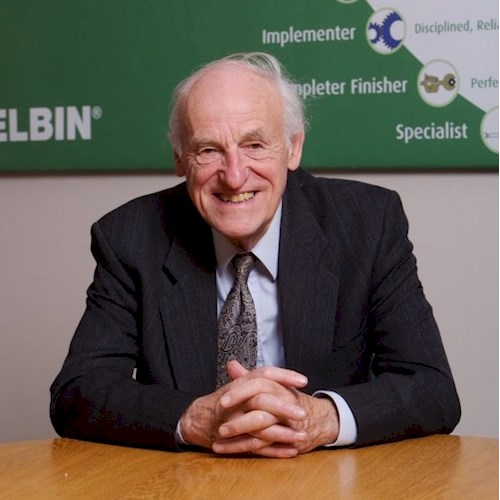


Meredith Belbin’s book Management Teams: Why They Succeed or Fail (1981) revolutionised understanding of team dynamics and team performance in the workplace. Belbin’s research at Henley Business School showed that having the best talent in teams mattered less than personality and the balance of different behavioural roles.
Meredith ‘planted’ me in my first graduate role in 1991, introducing me to an R&D team led by Simon Powell and Alasdair Barnett at Cambridge Product Innovation. Happy days! Meredith supported and believed in us and my overriding memory is of his kindness, curiosity and humour and, of course, his intelligence.
He made me feel as though he truly respected me and enjoyed our conversations. Meredith was incredibly inclusive, he valued everyone and discerned their strengths, creating a vibrant, positive atmosphere where people could be themselves.
I didn’t quite realise this at the time, but luckily for me I absorbed some of Meredith’s spirit at a formative time in my career as business psychologist. Meredith believed that everyone has something special to offer if only we can discover their unique strengths and encourage them to use them - and I do too. Thank-you Meredith. Belbin® - The Team Role Company
You can read below about the nine team roles that describe team behaviour and how they create a balanced team.
Meredith Belbin’s model shows nine team roles that can help create a balanced team. His research demonstrated that a balanced team was a higher performing team.
The nine roles are categorised into three main groups:
- Action-oriented roles – these roles focus on getting things done.
- Shaper – challenges the team to improve; dynamic and thrives under pressure.
- Implementer – turns ideas into practical actions; disciplined and efficient.
- Completer Finisher – ensures thoroughness and quality; detail oriented and perfectionistic.
- People-oriented roles – these roles focus on tram dynamics.
- Co-ordinator – clarifies goals and delegates tasks; confident and good at managing people.
- Teamworker – encourages collaboration; diplomatic and co-operative.
- Resource Investigator – brings new ideas and connections; enthusiastic and outgoing.
- Thought-oriented roles – these roles focus on creativity and problem-solving.
- Plant – comes up with innovative ideas; creative and unconventional.
- Monitor Evaluator – analyses and assesses ideas objectively; logical and strategic.
- Specialist – provides in-depth knowledge in a specific area; dedicated and expert-driven.
By understanding these roles and ensuring that a team has the right balance of individuals, teams can function more effectively. Team members personality traits influence the team roles they are best suited to - Belbin used Cattell’s 16 personality factor questionnaire in his original research.
As a trainee psychologist, one of my assignments (at IARC/Ashridge Management College) was to support the development of an expert system that ascertained likely team roles from individual’s 16PF scores. I learned that personality assessment has an important place in successful team selection, team building and development. My work helps organisations ensure that teams contain the right people who adopt the appropriate behaviours to ensure high performance. Belbin’s team role model is still highly relevant.